
From throwaway to feedstock: a brief history of beverage carton recycling
How aseptic cartons went from a 1950s Swedish invention to a 51% European recycling rate — and the role of PolyAl in the next decade.
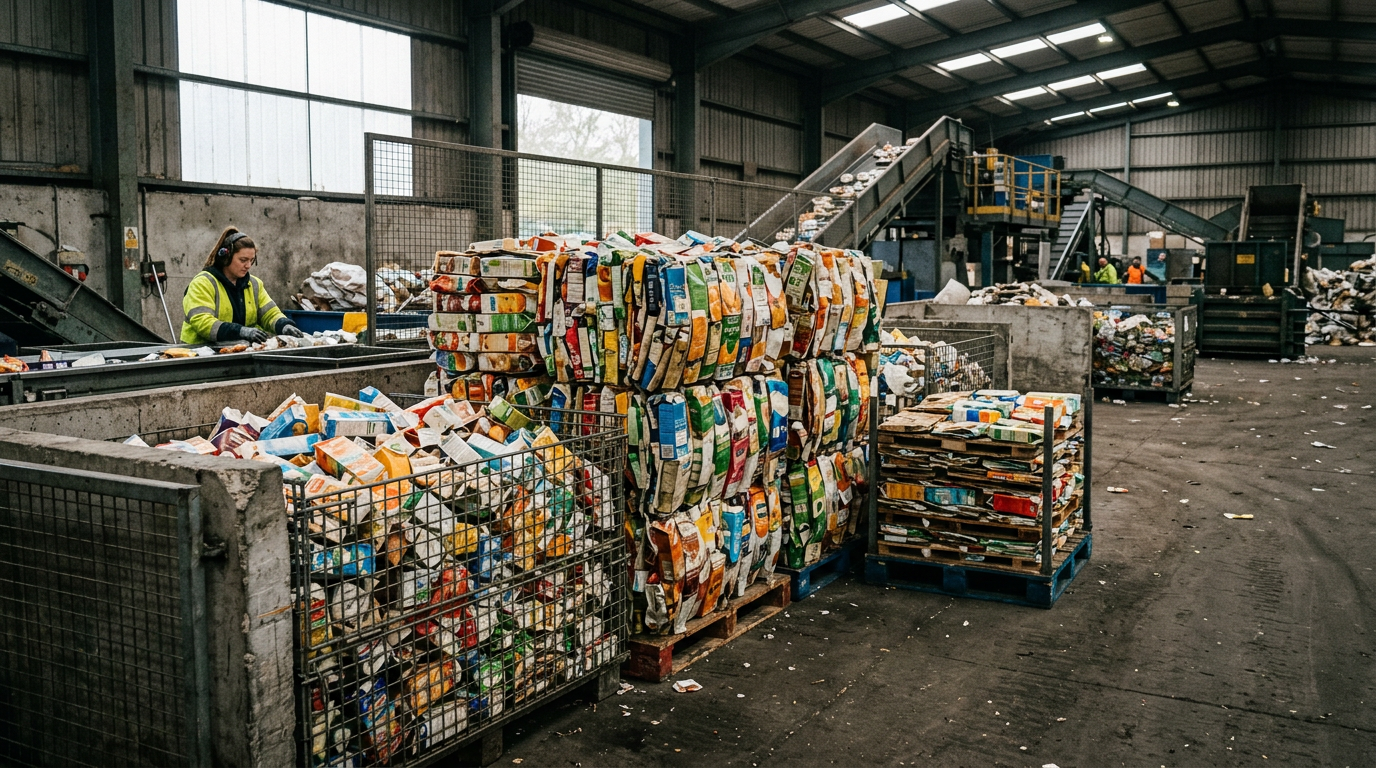
The aseptic beverage carton — a laminate of paperboard, polyethylene and a thin aluminium layer — was developed in Sweden in the 1950s and 1960s to keep milk and juice fresh without refrigeration. Cartons were initially used for milk, then soon expanded to juice, soup, wine and plant-based drinks. By 1990, billions of cartons were being placed on the market every year — and almost all of them ended up in landfill.
The first wave: paper recycling (1990s)
The European pulp industry was the first to recognise that beverage cartons contained ~75 % high-quality long-fibre cellulose. Specialised paper mills began accepting cartons as a fibre source: Stora Enso (Finland/Sweden), Saica (Spain), Smurfit Kappa, M-real, Lucart (Italy). By 2000, dozens of European mills could repulp cartons.
The reject problem (2000–2015)
Recovering the cellulose left behind a wet sludge of polyethylene and aluminium foil — the PolyAl reject. Most of it was sent to cement kilns or waste-to-energy plants. The fibre got recycled; the polymer-aluminium fraction did not. Industry critics called this "down-cycling".
The PolyAl breakthrough (2015–2024)
Three pioneering routes emerged in parallel:
- Mechanical compounding — pioneered in the Netherlands (Recon Polymers, 2014) and refined in Spain (GetPolyal partner network) and Czech Republic (Plastigram, Sokolov line). The PE and Al stay together as a single composite material.
- Mechanical separation — dedicated separation plants, including one opened at Hürth (Germany) in 2021 by a consortium of the main beverage-carton manufacturers, produce separate PE pellets and aluminium granulate.
- Pyrolysis and chemical recycling — multiple chemical recyclers across Europe accept PolyAl reject as a feed for steam crackers.
The numbers in 2026
- ~950,000 t/year of beverage cartons sold in the EU
- 51 % recycled in 2019, target 70 % by 2030 under PPWR
- ~240,000 t/year of PolyAl reject potentially available
- ~80,000 t/year currently processed into PolyAl pellets and equivalent products
- Remaining ~160,000 t/year still going to energy recovery — the growth opportunity
What's next
- New PolyAl plants under construction in Spain, Italy, France, Poland
- Industry commitment to recycle 90 % of cartons (long-term ambition)
- EU Packaging and Packaging Waste Regulation (PPWR) recycled-content quotas creating demand
- Solvent-based purification routes (SDP) potentially opening food-contact applications by 2030
From landfill to ISCC PLUS certified industrial pellet in roughly twelve years — beverage carton recycling is one of Europe's quiet circular-economy success stories.