
Injection moulding with recycled PolyAl: a process engineer's playbook
Screw geometry, barrel temperatures, holding pressure, mould venting and cycle-time targets when running PolyAl pellets in place of virgin HDPE.
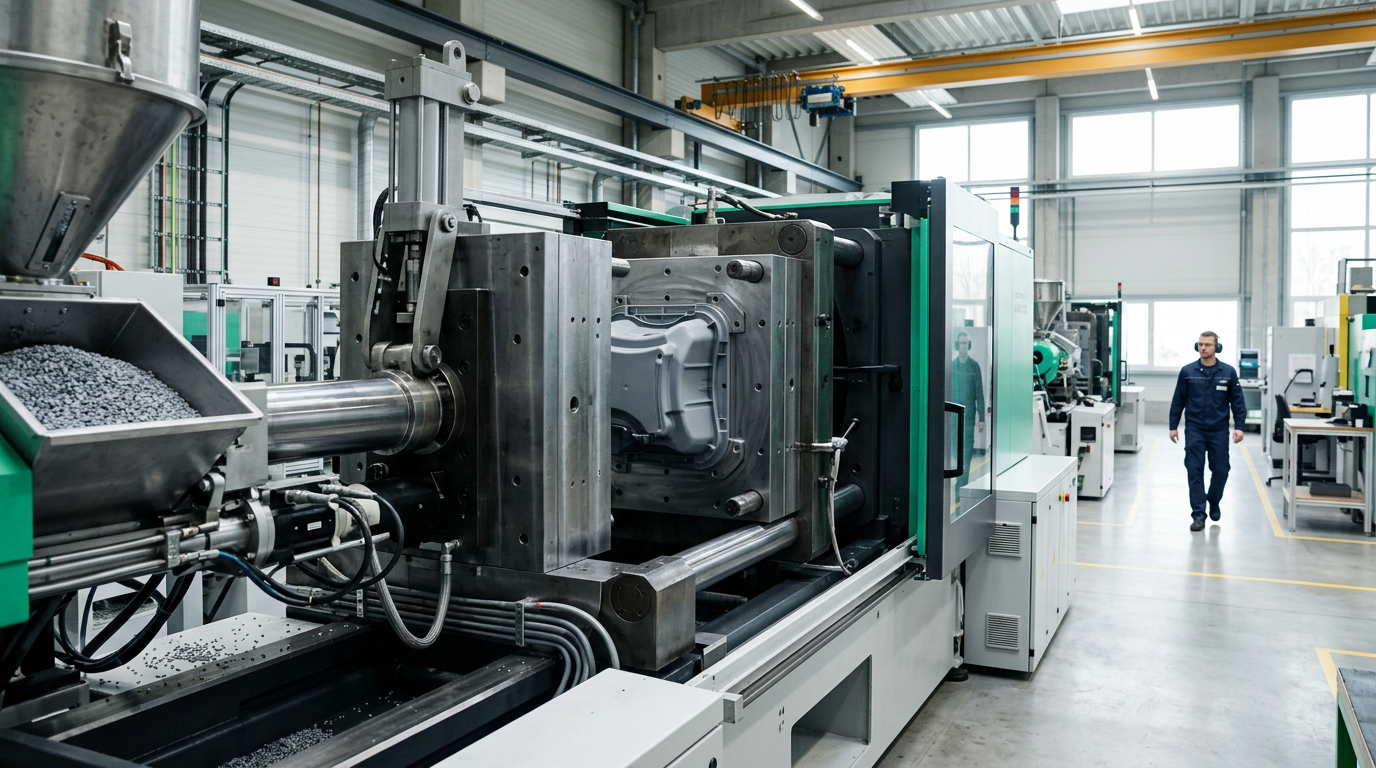
Switching an injection press from virgin HDPE to PolyAl pellets is rarely a matter of "drop in and run". The aluminium fraction (typically 10–13% ash) and the small residual fibre content change melt rheology, abrasion behaviour, venting requirements and cosmetic outcomes. This article distils what process engineers in our partner network have learned across more than 200 industrial setups.
Material at a glance
PolyAl pellets produced following UNE 53925:2026 typically present:
- MFI (190 °C / 2.16 kg): 2–4 g/10 min
- Density: 950–1050 kg/m³
- Ash content: up to 13 % (mostly metallic aluminium)
- Moisture (as supplied): < 0.15 %
- Vicat softening point: 90–100 °C
- Flexural modulus: 220–520 MPa
The rheology is comparable to a high-viscosity HDPE blow-moulding grade, with slightly higher melt strength because of the aluminium platelet filler.
Drying
PolyAl is supplied dry in 1000 kg big bags with PE liner. If the bag has been opened or stored in a humid warehouse for more than two weeks, dry at 70 °C for 2 hours in a desiccant dryer before processing. Wet PolyAl will produce silver streaks and small pinholes around aluminium-rich zones.
Screw and barrel
- Screw geometry: standard PE general-purpose screw, L/D 20:1 to 25:1, compression ratio 2.5:1 to 3:1
- Wear protection: specify a bimetallic barrel (Xaloy 800 or equivalent) and a nitrided or tungsten-carbide coated screw flight if you intend to run more than 500 t/year on the same press
- Non-return valve: standard ball check is fine; ring check works too
Expected wear is comparable to running 30 % talc-filled PP — manageable, but not zero.
Temperature profile
A typical four-zone profile for a 25 mm screw running PolyAl:
| Zone | Temperature |
|---|---|
| Feed throat | 40 °C |
| Zone 1 | 180 °C |
| Zone 2 | 200 °C |
| Zone 3 | 215 °C |
| Nozzle | 220 °C |
Keep melt below 240 °C to avoid burning residual paper-fibre. Do not idle the machine above 230 °C with material in the barrel for more than 5 minutes.
Mould design and venting
- Vents: open venting depth to 0.04 mm (vs 0.025 mm for HDPE).
- Gates: prefer fan or sub-marine gates with min land 1 mm. Pin-point gates work but show small witness marks.
- Polish: SPI A2 finishes are achievable but the aluminium specks will be visible. For aesthetic parts, choose VDI 30+ texture.
Holding pressure and cooling
- Injection speed: 60–80 mm/s for general-purpose parts.
- Holding pressure: 50–70 % of injection pressure for 3–6 s on parts with wall thickness 3–5 mm.
- Cooling time: budget +10 % over virgin HDPE.
Cycle-time benchmarks
- Euro pallet (1200×800, ~25 kg): 90–110 s on a 1500 t press
- Stackable crate (60 L): 45 s on a 600 t press
- Bench leg (3 kg): 35 s on a 250 t press
Cosmetics
PolyAl produces a characteristic dark grey to charcoal colour with metallic specks. For uniform black, add 1–2 % black masterbatch. Lighter colours require 4–6 % loading and will still show flecks — this is honest "recycled content" branding that ESG-conscious buyers actively want.
Common defects and fixes
- Silver streaks → dry 2 h at 70 °C
- Burn marks at the gate → reduce injection speed and add a vent
- Short shots → +5 °C melt, +10 % pressure
- Warp on flat parts → balance cooling between mould halves
- Excessive flash → check parting line; usually a real mechanical issue
Bottom line
PolyAl is a well-behaved injection material once dialled in. Budget half a day for tuning the first batch; subsequent runs are routine.