
PolyAl applications by sector: logistics, construction, urban design
A field guide to where PolyAl pellets are already replacing virgin HDPE in industry — with sector-specific specs.
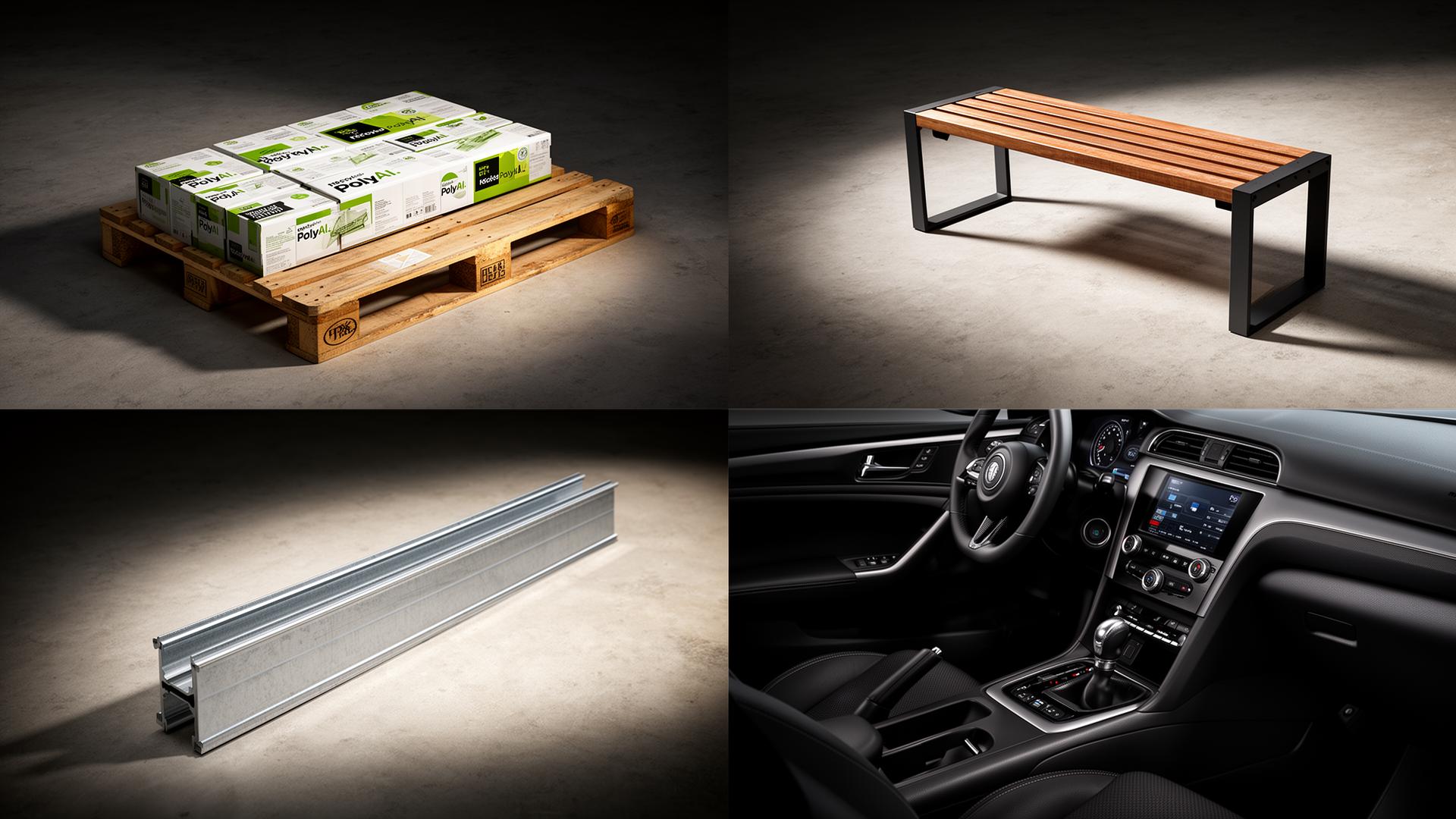
PolyAl is not a niche curiosity. As of 2026 it is being injected and extruded across three core industrial sectors. This guide walks through the most common applications, the specs that matter for each, and the reference projects you can cite.
1. Logistics: pallets, crates, dollies
Why PolyAl works: logistics customers care about stiffness, load-bearing capacity, dimensional stability, and resistance to cleaning chemicals — all areas where the aluminium-reinforced PE matrix performs as well as virgin HDPE at a lower carbon cost.
- Plastic pallets (Euro 1200×800, US 1200×1000): injected from PolyAl pellets in 25–30 kg presses, target Vicat 90–100 °C, flexural modulus 400–520 MPa.
- Stackable crates and bins for closed-loop logistics: extrusion or injection.
- Dollies and wheels for warehouse automation.
Reference standard for non-food contact pallets: UNE 56875:2021 (cleaning chemical resistance) and EUMOS 40509 (load testing).
2. Construction: profiles, decking, fencing, formwork
Why PolyAl works: construction needs cheap, durable, weather-resistant profiles that survive 20+ years outdoors without painting. PolyAl's UV stability is comparable to filled HDPE; its aluminium load improves dimensional stability against thermal cycling.
- Decking and cladding boards (extruded profiles, 140–200 mm width)
- Fencing posts and panels
- Concrete formwork stakes (replacing single-use timber)
- Drainage and cable conduit profiles (non-pressure)
3. Urban design and street furniture
Why PolyAl works: municipalities want recycled-content credentials for tenders (PPWR, EU Green Public Procurement). PolyAl is produced following UNE 53925:2026 and provides post-consumer content with a documented mass-balance trail.
- Benches, planters, picnic tables
- Litter bins and dog-waste stations
- Tree grates, bollards, traffic separators
- Playground non-structural elements
What PolyAl is not used for
- Direct food-contact packaging (see EU 2022/1616 article)
- Pressure pipes (insufficient long-term hydrostatic strength)
- Electrical insulation requiring HV ratings
- Medical devices