
Defect troubleshooting in PolyAl parts: a quality engineer's field guide
Visual identification of common defects in injection-moulded and extruded PolyAl parts, root causes and corrective actions.
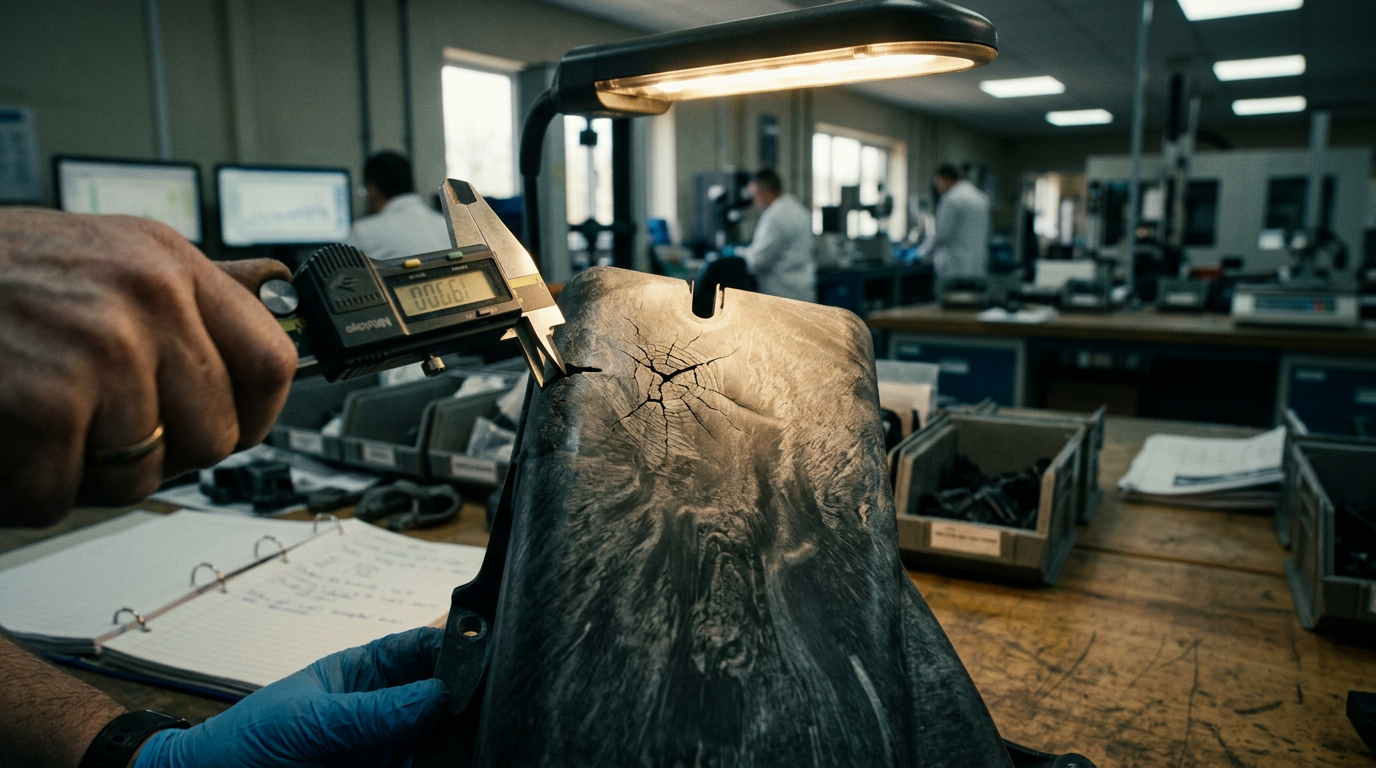
Quality teams new to PolyAl often misdiagnose defects as material problems when the root cause is process or design. This field guide walks through the ten most common visual defects, their root causes and the fastest fixes.
1. Silver streaks (radial silver lines from gate)
- Cause: moisture in the pellet
- Fix: dry 2 h at 70 °C; check storage humidity
2. Burn marks (brown discoloration at gate or mould vents)
- Cause: trapped air igniting at high injection speed
- Fix: reduce injection speed at end of fill; deepen vents to 0.04 mm; check melt temperature
3. Short shots
- Cause: insufficient melt temperature, low injection pressure or gate too small
- Fix: +5 °C melt, +10 % pressure, recheck gate dimensions
4. Sink marks on thick walls
- Cause: insufficient holding pressure or holding time
- Fix: +1 s holding time, +10 % holding pressure, redesign rib (60 % of wall thickness max)
5. Warpage on flat parts
- Cause: differential cooling between mould halves
- Fix: balance cooling channels; consider beryllium copper inserts in hot zones
6. Excess flash (parting line escape)
- Cause: high injection pressure, mould wear, or low clamp force
- Fix: check clamp tonnage, inspect parting line, reduce pressure 5 %
7. Dark specks visible in part
- Cause: degraded material from previous run, or contamination
- Fix: purge with virgin HDPE; verify clean hopper; check screen pack
8. Drag marks on extruded profile
- Cause: aluminium agglomerates being scraped at the calibrator
- Fix: increase melt filtration mesh; reduce melt temperature 5 °C
9. Brittle failure under impact
- Cause: design with sharp internal corners, or part too thin (< 3 mm)
- Fix: fillet corners ≥ 2 mm radius; increase wall thickness; specify higher-toughness PolyAl grade
10. UV cracking after 12+ months outdoor
- Cause: insufficient UV stabiliser package
- Fix: re-formulate with HALS 0.3 % + UV absorber 0.2 % + carbon black 1.5 %
When to suspect the material vs the process
Process-related defects (silver, burn, short, sink, warp, flash) account for ~85 % of issues. Material-related issues (specks, brittle, UV) account for ~15 % and require sampling and CoA review.
Bottom line
Keep a defect log indexed by mould, batch number and date. Cross-reference with the per-batch CoA. Within three months a quality team will know which defects are process-controllable and which require a supplier conversation.