
Case studies·8 min read·
PolyAl in marine and aquaculture: pontoons, fenders and floating walkways
Why a polyethylene-aluminium composite is uniquely well-suited to salt water, biofouling resistance and 25-year marine service.
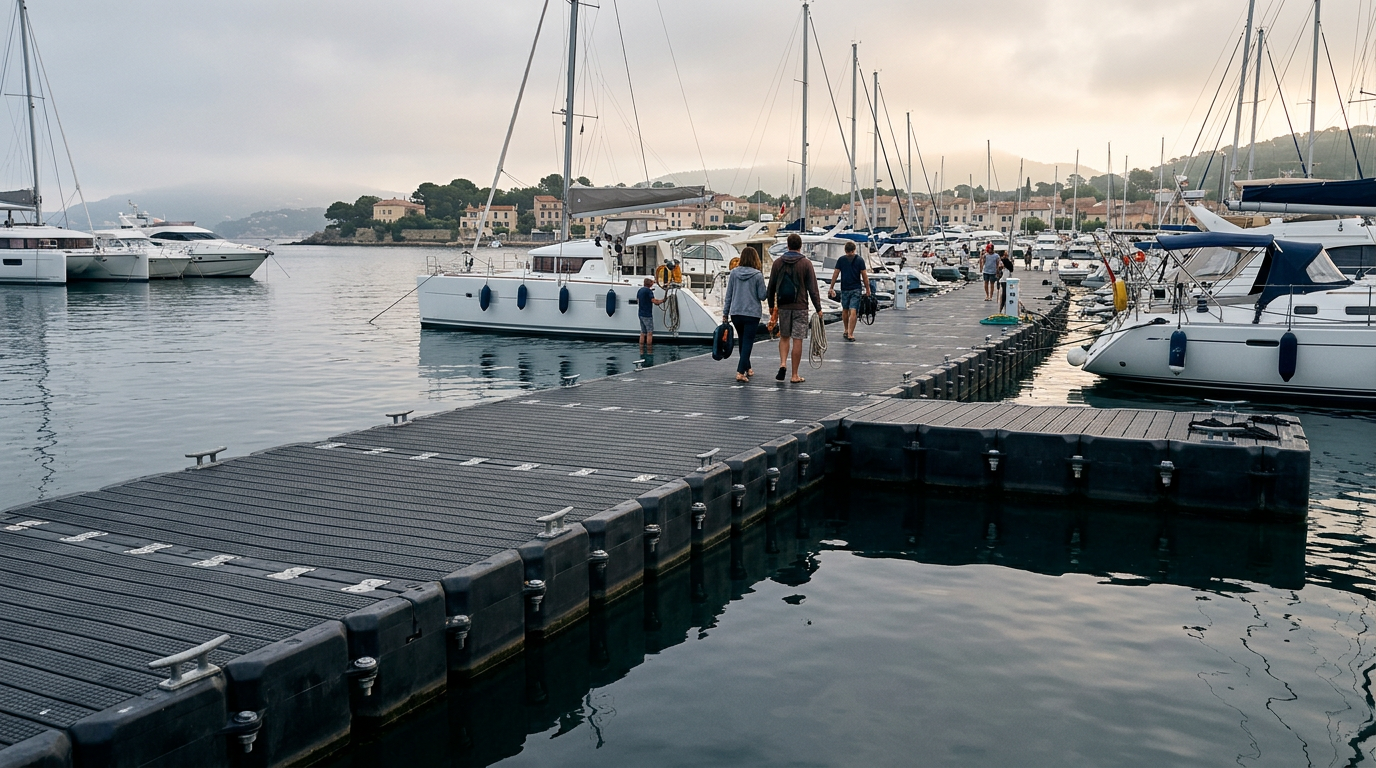
The marine environment is brutal: UV, salt, abrasion, biofouling, freeze-thaw cycles, hurricane stress. Most plastic compounds fail within 5 years. PolyAl, by contrast, has been performing in Mediterranean and Atlantic marinas since 2018 with no documented structural failures.
Why PolyAl works in the sea
- Hydrolysis resistance: polyethylene is one of the most hydrolytically stable polymers known
- Aluminium reflective UV barrier: protects the bulk from photo-oxidation
- Closed-cell, no water absorption: < 0.05 % water uptake at 24 h
- Biofouling: smooth surface and low surface energy reduce algae and barnacle adhesion vs concrete and timber
- Freeze-thaw: no water inside the matrix means no expansion damage
Applications in production
- Modular floating pontoons: replace timber decking on marina walkways. PolyAl planks 140×35 mm on aluminium frames, 25-year warranty achievable.
- Dock fenders: rotomoulded hollow profiles filled with closed-cell foam.
- Aquaculture cage walkways: salmon and sea bass farms in Norway, Greece, Chile.
- Floating photovoltaic floats: structural floats supporting solar panels on calm waters.
- Marina cleats and bollards: injection-moulded with stainless inserts.
Spec considerations
- Add 1.5 % carbon black + 0.3 % HALS for marine UV stabilisation
- Use stainless 316 fasteners; standard 304 corrodes in spray zones
- Design for thermal expansion (PolyAl: 1.1 mm/m per 10 °C); leave 4–6 mm gaps on decking
Compliance
- ISO 13628 for offshore plastic components (where applicable)
- Lloyd's Register and DNV provisional certification available for floating PV applications
- IMO MARPOL: PolyAl is a registered, traceable industrial material — no microplastic concerns under standard installation
Marine engineers who have switched from FRP and tropical hardwood to PolyAl report comparable lifetime, lower maintenance, and a defensible recycled-content story for tender documents.