
How long does PolyAl last outdoors? UV, weathering and 20-year service life
Accelerated weathering data, real-world ageing observations and stabiliser packages for outdoor PolyAl applications.
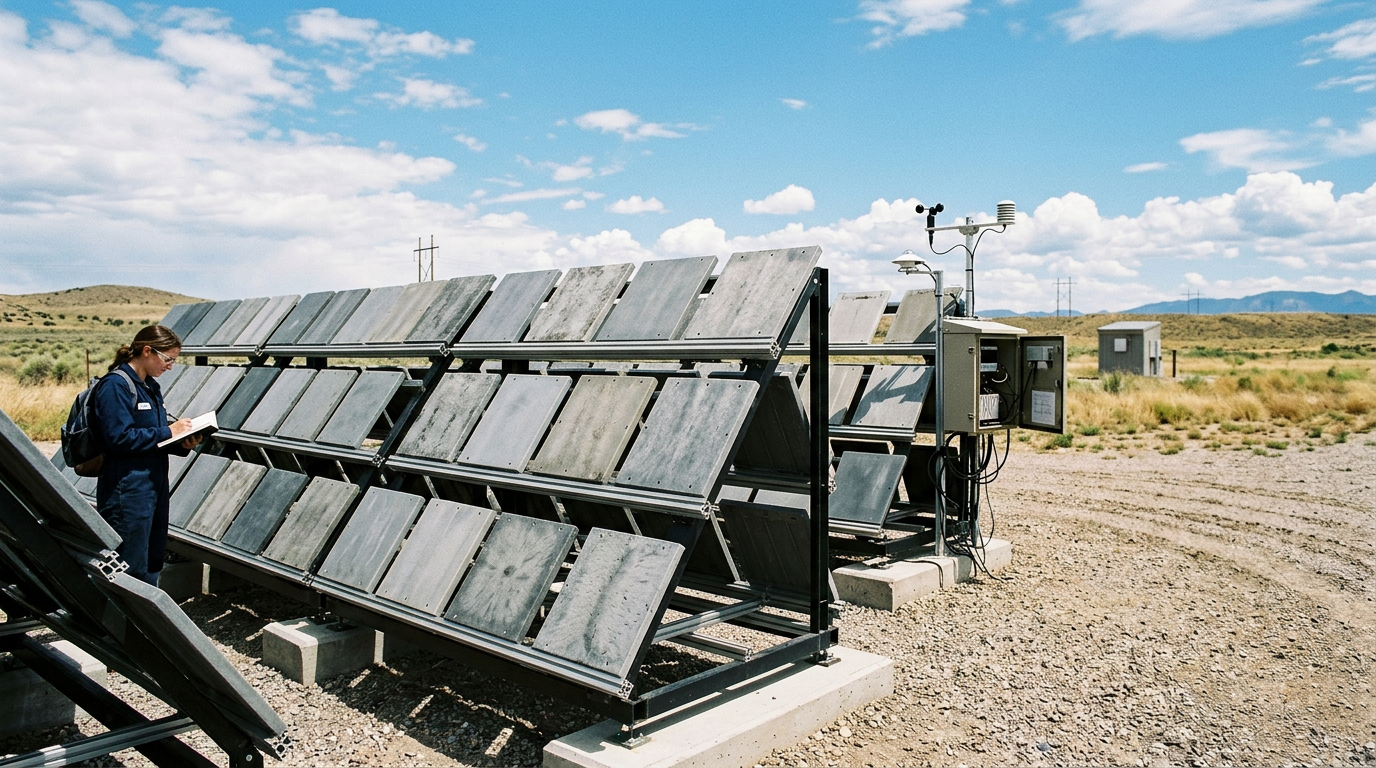
Buyers specifying PolyAl for fences, decking and street furniture invariably ask one question: will it last twenty years outdoors? The honest answer is "yes, if specified correctly". This article explains the data behind that answer.
What kills polyethylene outdoors
Unstabilised polyethylene chalks, cracks and disintegrates within 18–36 months of UV exposure. Three failure mechanisms operate together:
- 1Photo-oxidation — UV breaks C–H bonds and triggers chain scission.
- 2Thermal cycling — daily expansion/contraction stresses the matrix.
- 3Hydrolysis at the aluminium interface — water plus dissolved oxygen at the metal/polymer boundary.
The aluminium fraction in PolyAl actually helps: aluminium reflects ~85 % of incident UV in the 280–400 nm band, so the bulk of the part receives less radiation than equivalent unfilled HDPE.
Accelerated weathering data
Available test data on PolyAl pellets stabilised with a standard HALS + UV absorber package (typical for outdoor HDPE):
- ISO 4892-2 Cycle 1 (Xenon arc, 1500 h, equivalent to ~5 years Central Europe):
- - Tensile retention: 88 %
- - Elongation at break retention: 76 %
- - ΔE colour change: 4.2 (visible but moderate)
- ISO 4892-2 (4500 h, equivalent to ~15 years):
- - Tensile retention: 71 %
- - Elongation at break retention: 52 %
- - ΔE: 8.5
For structural pallets, the rule of thumb in our network is: stabilised PolyAl retains > 70 % of mechanical properties after 15 years outdoors in Central Europe, equivalent to a service life of 20 years for non-load-bearing applications.
Stabiliser packages
For outdoor specification, request:
- HALS (Hindered Amine Light Stabiliser): 0.2–0.3 %
- UV absorber (Tinuvin 326 type): 0.1–0.2 %
- Antioxidant (Irganox 1010 + Irgafos 168): 0.1 % each
- Carbon black: 1–2 % (best UV protection at low cost; gives charcoal grey/black colour)
Light-coloured PolyAl (without carbon black) requires a heavier UV-absorber package and reaches ~12 years comfortably.
Real-world observations
- Pallets from the first commercial PolyAl batches (2018) used in outdoor logistics yards in Spain and Portugal show < 5 % cracking at year 7.
- Urban benches installed in 2019 in Mediterranean climates show a slight surface chalking but no structural degradation.
- Fencing posts buried 80 cm deep show no soil-side degradation at year 6.
What to avoid
- Mechanical loads at high temperature (e.g., heavy storage on pallets at +50 °C in tropical sun) accelerate creep more than UV does.
- Cleaning with aromatic solvents is unnecessary and can locally degrade the surface.
- White or pastel colours without UV absorbers will fade visibly within 2 years.
Bottom line
With a standard outdoor stabiliser package, PolyAl is a 20-year material — comparable to virgin HDPE outdoor compounds, at a fraction of the carbon cost.