
PolyAl decking vs Wood-Plastic Composite (WPC): a side-by-side comparison
Mechanical, thermal, environmental and cost comparison between PolyAl-based decking boards and traditional WPC.
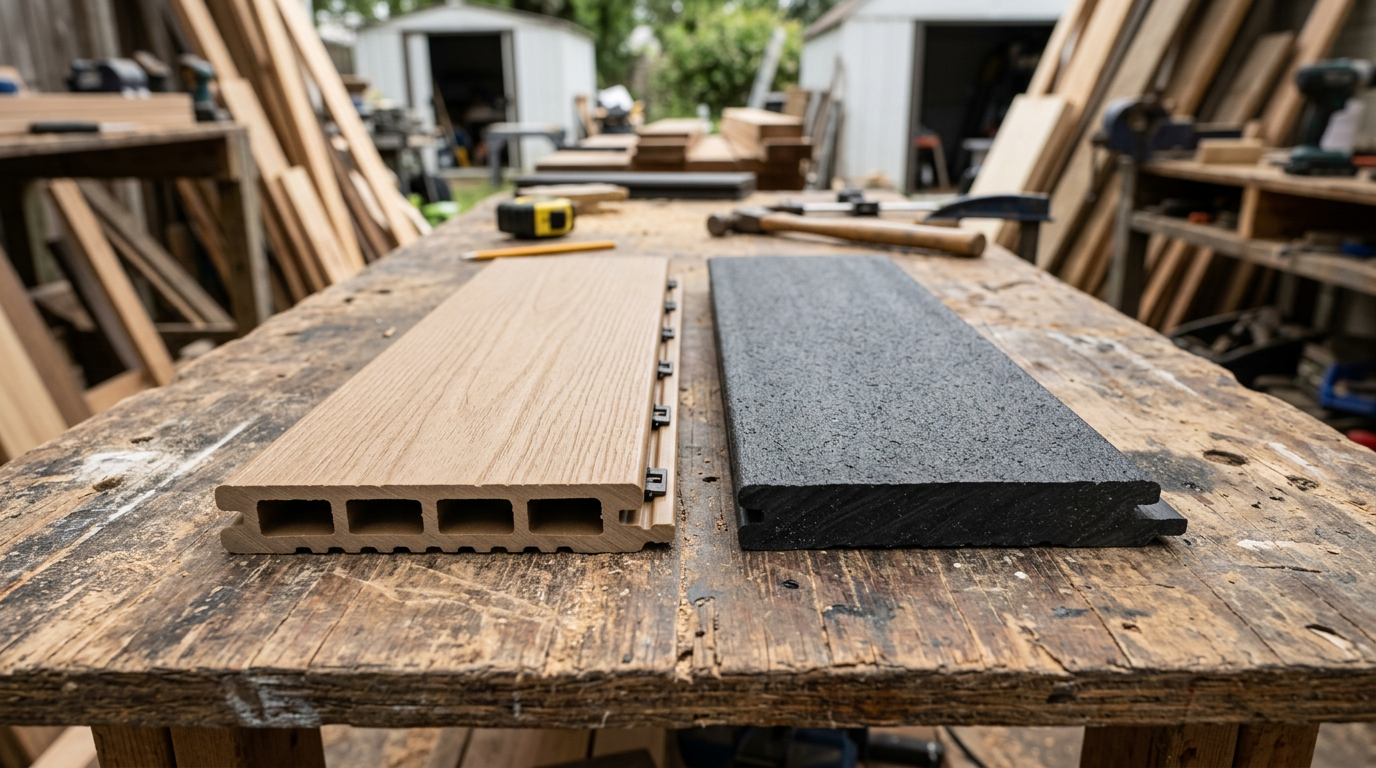
Wood-Plastic Composite (WPC) decking is the established outdoor recycled-content option in Europe and North America. PolyAl decking is the newer challenger. Both are extruded, both come in similar profiles — but they behave differently. Here is the engineering and procurement view.
Composition
- WPC: 50–70 % wood flour + 30–50 % HDPE/PP + 2–5 % additives. Wood flour is mostly virgin sawmill residue.
- PolyAl: 87–90 % recycled polyethylene + 10–13 % aluminium (post-consumer beverage cartons). 100 % post-consumer recycled feedstock.
Mechanical properties (typical 140×25 mm board)
| Property | WPC | PolyAl |
|---|---|---|
| Density (kg/m³) | 1100–1300 | 950–1050 |
| Flexural modulus (MPa) | 2500–4500 | 220–520 |
| Tensile strength (MPa) | 18–25 | 10–15 |
| Water absorption 24 h (%) | 0.7–2.5 | < 0.05 |
| Thermal expansion (10⁻⁵/°C) | 5 | 11 |
| Slip resistance (DIN 51097) | R10–R11 | R11–R12 |
Read this carefully: WPC is stiffer (so spans further) and stronger in tension. PolyAl is lighter, virtually waterproof, and has better wet-slip resistance. PolyAl expands and contracts more with temperature.
Outdoor durability
- Mould and rot: WPC contains wood, so it can develop surface mould in shaded humid climates. PolyAl is biologically inert.
- UV: Both fade over time. WPC fades brown/grey. PolyAl, especially in dark grey, fades less visibly.
- Cleaning: PolyAl tolerates pressure washing and industrial cleaners (UNE 56875:2021). WPC requires gentler care.
Carbon footprint
- WPC: ~1.5–2.0 kg CO₂e/kg (mostly the virgin HDPE/PP fraction)
- PolyAl: ~0.5–0.9 kg CO₂e/kg (cradle-to-gate)
A decking project of 1000 m² (~5 t boards): switching from WPC to PolyAl saves roughly 5–6 t CO₂e.
Cost
- WPC ex-works (Europe): €1.10–1.40/kg material; €25–45/m² installed
- PolyAl ex-works (Europe): €0.85–1.20/kg material; €22–40/m² installed
Prices vary by board geometry and cap layer. PolyAl is typically 10–20 % cheaper at material level.
End-of-life
- WPC: difficult to recycle (mixed wood/plastic), usually goes to waste-to-energy.
- PolyAl: fully recyclable into new PolyAl pellets through a standard wash-extrusion line.
When to choose which
- Choose WPC if: you need long unsupported spans, or you want a wood-look surface.
- Choose PolyAl if: you want lower carbon, lower price, lower water absorption, better cleaning chemistry tolerance, and full end-of-life recyclability — and you accept a more "industrial" aesthetic.