
What is PolyAl? The complete reference guide (2026)
PolyAl is the polyethylene-aluminium fraction recovered from used beverage cartons after paper extraction. Here is everything industrial buyers, recyclers and regulators need to know.
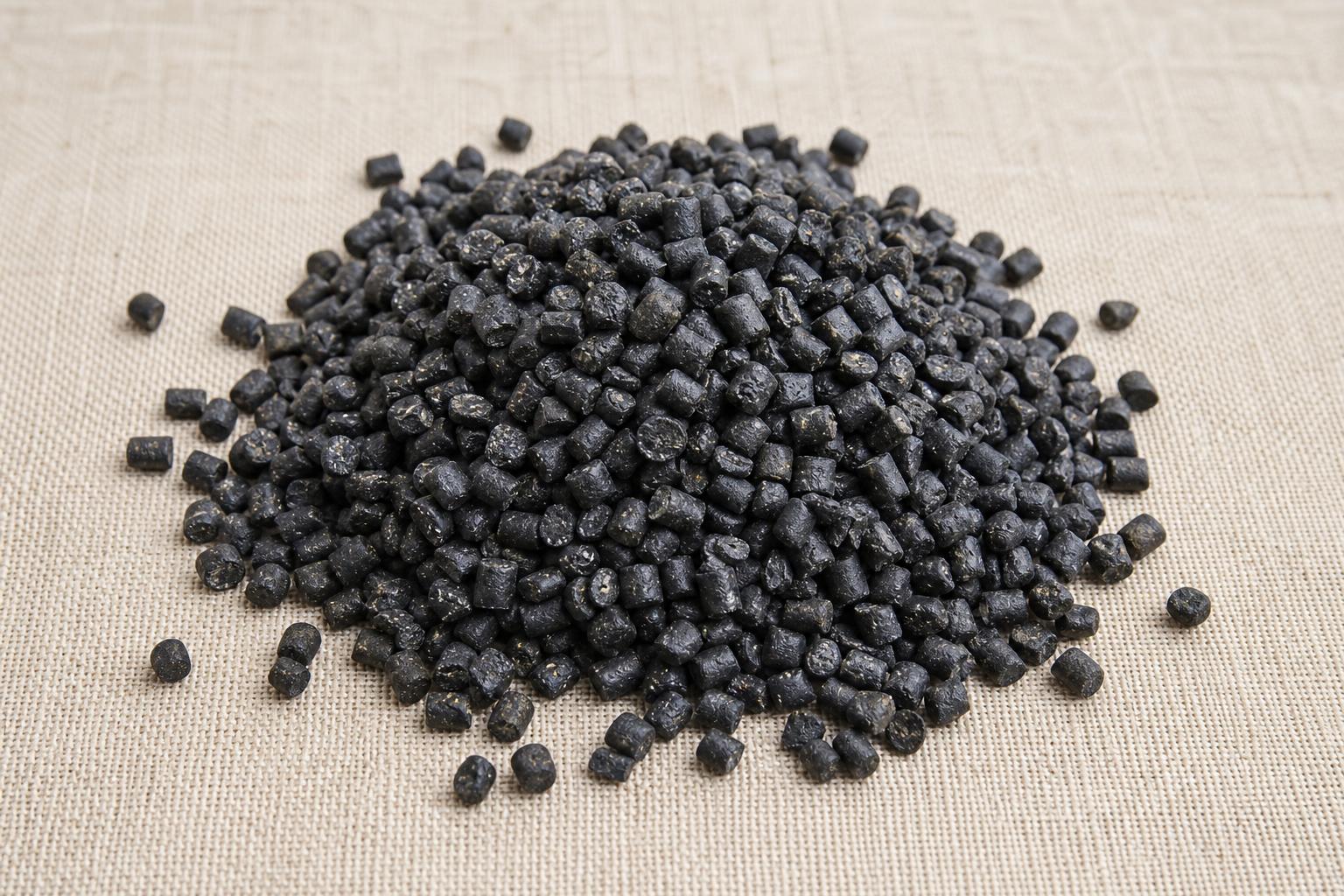
If you have ever drunk milk, juice or plant-based drink from a carton, you have handled PolyAl. The cardboard outer layer is what most people see — but inside every carton there is a thin sandwich of polyethylene and aluminium that keeps the contents shelf-stable for months without refrigeration. That sandwich is PolyAl (also spelled Poly-Al, polyAl or PolyAL).
This article is the most comprehensive English-language reference on PolyAl available online. We will cover the definition, composition, recovery technologies, technical standards, applications, market players and the regulatory framework — with primary sources you can verify yourself.
1. Definition: what exactly is PolyAl?
PolyAl is the residue of polyethylene (PE) and aluminium foil that remains after paper mills have recovered cellulose fibres from used beverage cartons. A typical aseptic beverage carton is composed, by mass, of:
- ~70–75% paperboard (cellulose fibre — the structural layer)
- ~20–24% polyethylene (multiple thin layers that provide moisture and oxygen barrier and seal the package)
- ~4–6% aluminium foil (oxygen and light barrier in long-life aseptic cartons)
When a used beverage carton arrives at a paper mill, it is pulped in water. The cellulose fibres dissolve into the slurry and are recovered for new paper and board. The polyethylene and the aluminium foil — which together account for roughly one quarter of the carton's mass — do not dissolve. They emerge as a wet, mixed reject material called PolyAl.
Historically that reject was burned for energy or sent to landfill. PolyAl recycling means turning it into a usable industrial material instead.
2. Composition and material properties of recovered PolyAl
After it leaves the paper mill, PolyAl is washed, dried and processed into pellets. The resulting compound is essentially a polyethylene matrix with aluminium as a mineral filler, plus minor residues of paper fibre and ink.
Typical specifications of PolyAl pellets (UNE 53925:2026 reference framework):
- Density: 950 – 1050 kg/m³
- Melt flow index (MFI): 2 – 4 g/10 min @ 190 °C / 2.16 kg
- Ash content (mostly aluminium): up to 13%
- Moisture: < 0.15%
- Tensile strength: 10 – 15 MPa
- Vicat softening point: 90 – 100 °C
- Flexural modulus: 220 – 520 MPa
Mechanically, PolyAl behaves like a moderately stiff, high-density polyethylene compound. The aluminium load acts as a natural rigidising filler — comparable in function to talc or calcium carbonate, but recovered from the original packaging rather than mined.
3. How PolyAl is recovered: the four main technologies
There are four industrial processes in operation today for converting carton-mill PolyAl reject into a marketable raw material.
a) Mechanical washing and pelletising
The dominant approach in mainland Europe. The PolyAl reject is shredded, washed to remove residual fibre and organic contamination, dried, and processed through a twin-screw extruder. The output is a pellet that retains both the polyethylene and the aluminium together as a single composite material.
Operators: GetPolyal (Spain), Recon Polymers (Netherlands), Plastigram Industries (Czech Republic, Sokolov line).
b) Mechanical separation of PE and aluminium
A more sophisticated route that physically separates the polyethylene from the aluminium foil after pulping. The result is two distinct streams: clean PE pellets and aluminium granulate, each sold separately.
Operator: Palurec GmbH (Hürth, Germany — operating at the Knapsack chemical park since 2021, expanded capacity in 2024). Funded by the main beverage-carton manufacturers.
c) Selective dissolution-precipitation
A solvent-based laboratory and pilot-scale process described in the peer-reviewed literature (Resources, Conservation and Recycling, 2020). Polyethylene is selectively dissolved in a solvent at controlled temperature, separated from the aluminium, and then precipitated by cooling. Yields very high purity PE.
d) Pyrolysis
Thermal cracking of the PolyAl reject in the absence of oxygen, producing pyrolysis oil (chemically equivalent to virgin naphtha) and a metallic aluminium residue. Used by chemical recyclers as a feed for steam crackers.
4. Why PolyAl matters: the numbers
Europe consumes approximately 950,000 tonnes of beverage cartons every year. According to the Alliance for Beverage Cartons and the Environment (ACE), the EU recycling rate for cartons reached 51% in 2019 and the industry has committed to reach 70% by 2030 (90% as a long-term ambition).
Of every recycled carton, roughly 25% — the PolyAl fraction — historically had nowhere to go except waste-to-energy plants. Recovering it as a pellet means:
- Roughly 240,000 tonnes per year of polyethylene-aluminium composite kept in the materials economy in Europe
- Avoidance of approximately 1.6 tonnes of CO₂eq per tonne of PolyAl, compared with virgin HDPE production
- Direct contribution to the EU Packaging and Packaging Waste Regulation (PPWR) recycled-content quotas applicable from 2030
- Recovery of aluminium that would otherwise be lost to slag in incinerators
In 2024 the carton industry announced a €40 million investment to expand European PolyAl recycling capacity by more than 40,000 tonnes per year, the equivalent of 4 billion carton units.
5. What PolyAl pellets are used for
PolyAl pellets are sold as a drop-in replacement for virgin HDPE in injection moulding and extrusion. The most common end-use applications are:
- Industrial pallets — the largest single market, taking advantage of the dimensional stability and chemical resistance
- Plastic profiles — fencing, decking, urban furniture, formwork
- Logistics crates and bins — washable, resistant to cleaning chemicals
- Cable trays and non-electrical conduits
- Composting bin bodies
- Acoustic panels when foamed
- Geotechnical drainage profiles
- Marina decking and fender boards
PolyAl is not a food-contact material. The recovered material has not been certified for direct contact with food or drink and is intended only for industrial and non-contact applications.
6. PolyAl standard: the UNE 53925:2026 framework
In 2026 the Spanish standardisation body AENOR published UNE 53925:2026, the first dedicated European technical standard for recycled PolyAl pellets. It defines:
- Minimum and maximum thresholds for MFI, density, ash content, moisture and tensile strength
- Sampling protocols and per-batch documentation requirements
- Traceability rules linking each batch back to the certified carton recycler that supplied the feedstock
Independently, profiles extruded from PolyAl have passed third-party laboratory testing for resistance to cleaning chemicals (UNE 56875:2021 — intensive-use rating) and maximum profile torsion (UNE-EN 14195:2015 — 0.040 ≤ 0.1 limit), confirming suitability for demanding industrial environments.
7. The PolyAl industry today
A handful of European companies dominate the PolyAl recycling landscape:
- GetPolyal — Spain. Manufactures PolyAl pellets following UNE 53925:2026 in 10-tonne homogeneous batches.
- Palurec GmbH — Germany. Joint venture of the main beverage-carton manufacturers. Specialises in physical separation of PE and aluminium.
- Plastigram Industries a.s. — Czech Republic. Produces aluLDPE regranulate for injection moulding and technical applications.
- Recon Polymers — Netherlands. Converts PolyAl into engineering compounds.
All four serve a market that is expanding faster than any single operator can match, driven by PPWR recycled-content mandates, voluntary corporate Scope 3 reduction targets, and EU Green Public Procurement criteria.
8. The bottom line
PolyAl is no longer a niche curiosity. It is a defined material with its own technical standard, its own recycling industry, and a growing book of industrial applications. For manufacturers facing PPWR compliance from 2030, it is one of the cleanest paths to ISCC PLUS certified post-consumer recycled content with full per-batch traceability.
If you want to see a PolyAl technical sheet, request a sample batch, or run the impact calculator for your annual volume — the rest of this site will take you there.